
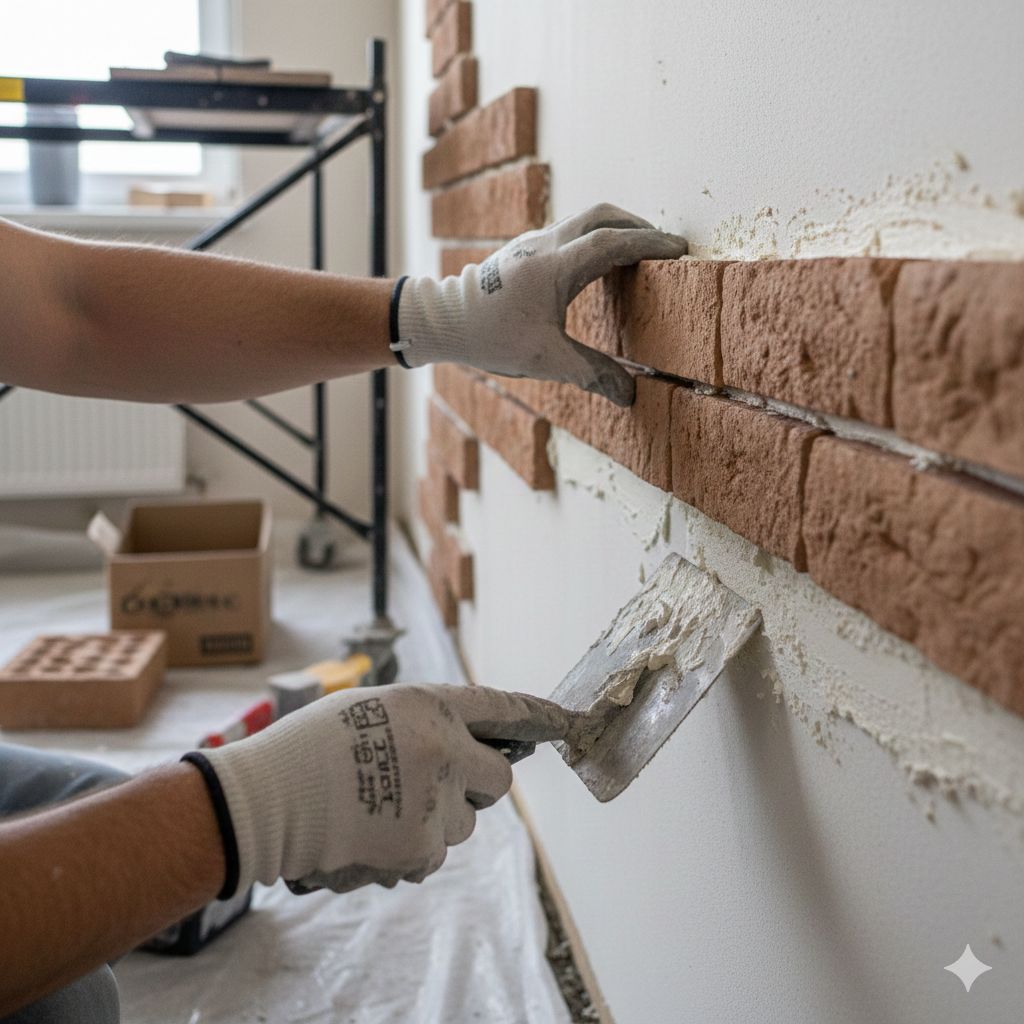
Most cladding fails the same way: not at the face, but behind it. The standard 'dot-and-dab' method, five blobs of adhesive per piece, leaves a hollow cavity behind every slip. It's faster to apply and it looks fine on day one. The problem shows up later.
Those cavities are where moisture collects. On an exterior wall, water that finds its way behind a slip pools in the void, and in the first hard frost it expands and pushes the slip off the wall. Inside, the same hollows sound drummy and telegraph every knock.
We mount full-surface instead. Adhesive is combed across the entire back of the slip and the entire substrate, then the piece is pressed and wiggled until the bed spreads edge to edge, a slight suction, the 'vacuum effect', pulls it tight with no air gap left behind.
It's slower, and it uses more adhesive. In exchange you get a wall with no voids to trap water, nothing to freeze and lift, and a face bonded across its whole area rather than at five points. Over a twenty-year wall, that difference is the wall.
For large-format pieces we adapt the technique, adhesive to the edges with a deliberate centre gap, but the principle holds: seal the perimeter and leave nowhere for water to live.